Geometry 3b: Mastery Questions |
| Guidance Notes - To answer each question, click on the letter that corresponds to the correct answer. You then need to click the 'Check' button to see if you are correct.
If your answer is incorrect, you will be given a hint on how to get the correct answer. You then need to click the 'Try again' button to attempt the question once more. |
| 1. |
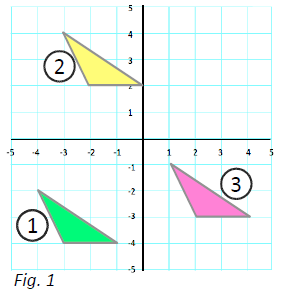
Which vector correctly describes the single translation that moves triangle 1 to triangle 3 in Fig. 1?
Incorrect. Hint - Look at page 3 in Geometry 3b unit.
|
| 2. |
Which vector correctly describes the single translation that moves triangle 2 to triangle 3 in Fig. 1 (above)?
Incorrect. Hint - Look at page 3 in Geometry 3b unit.
|
| 3. |
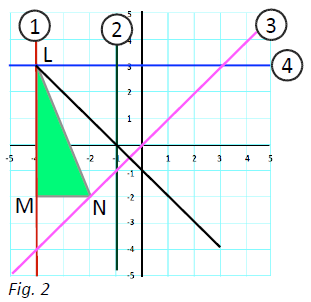
Reflecting the triangle LMN (Fig. 2) in which line leaves exactly two vertices unchanged (invariant)?
Incorrect. Hint - Look at page 6 in Geometry 3b unit.
|
| 4. |
If the LMN in Fig. 2 (above) is reflected in the line 3, what are the coordinates of L'?
Incorrect. Hint - Look at page 7 in Geometry 3b unit.
|
| 5. |
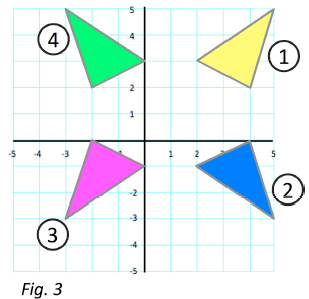
If triangle 1 in Fig.3 is reflected in the line x = 1, which triangle is the image of triangle 1?
Incorrect. Hint - Look at page 6 in Geometry 3b unit.
|
| 6. |
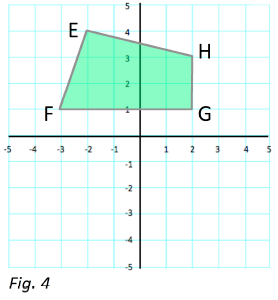
If the shape EFGH in Fig. 4 is reflected in the line y = -1, what are the coordinates of F'?
Incorrect. Hint - Look at page 6 in Geometry 3b unit.
|
| 7. |
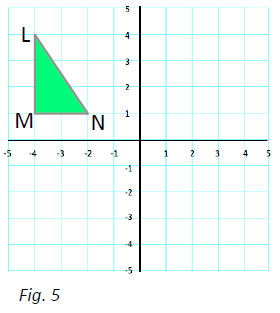
If the triangle LMN in Fig.5 is rotated about the origin through 180°, what are the coordinates of M'?
Incorrect. Hint - Look at page 11 in Geometry 3b unit.
|
| 8. |
If the triangle LMN in Fig.5 (above) is rotated 90° anticlockwise about the origin, what are the coordinates of N'?
Incorrect. Hint - Look at page 11 in Geometry 3b unit.
|
| 9. |
If the triangle LMN in Fig. 5 (above) is rotated 90° clockwise about N, what are the coordinates of L'?
Incorrect. Hint - Look at page 11 in Geometry 3b unit.
|
| 10. |
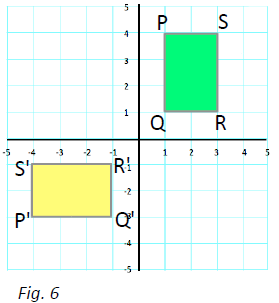
The rectangle PQRS in Fig. 6 has been rotated through 90° anticlockwise onto the shape P'Q'R'S'. What are the coordinates of the centre of rotation?
Incorrect. Hint - Look at page 14 in Geometry 3b unit.
|
| 11. |
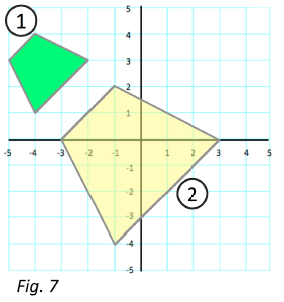
Shape 1 has been transformed into shape 2 in Fig. 7. How is this transformation best described?
Incorrect. Hint - Look at page 15 in Geometry 3b unit.
|
| 12. |
A model bus has a scale of 1: 40. If the height of the bus is 4.4m, how tall is the model?
Incorrect. Hint - Look at page 20 in Geometry 3b unit.
|
| 13. |
The scale on a map is 1 cm represents 20 miles. If the distance between Plymouth and Norwich on the map is 16 cm, how far is it?
Incorrect. Hint - Look at page 20 in Geometry 3b unit.
|
| 14. |
A scale of 1:100000 is equivalent to:
Incorrect. Hint - Look at page 20 in Geometry 3b unit.
|
| 15. |
The actual distance between London and Tokyo is approximately 9500 km. If the scale of a map is 1: 80 000 000, what is the approximate distance between the two cities on the map?
Incorrect. Hint - Look at page 20 in your textbook.
|
| ⮜Back to Year 7 Menu ⮜Back to Year 8 Menu |